A 30-minute checklist for trying any new AI model
Release news checked 12 October 2026. Sources disagree on some model names, so confirm on the vendor's own page.
Model news moves fast, and the early coverage is often inconsistent. One tracker said October 2026 opened without a frontier launch and with a cluster of smaller, specialised models, while other sources use different names for the same releases. That is exactly why a fixed test beats reading headlines.
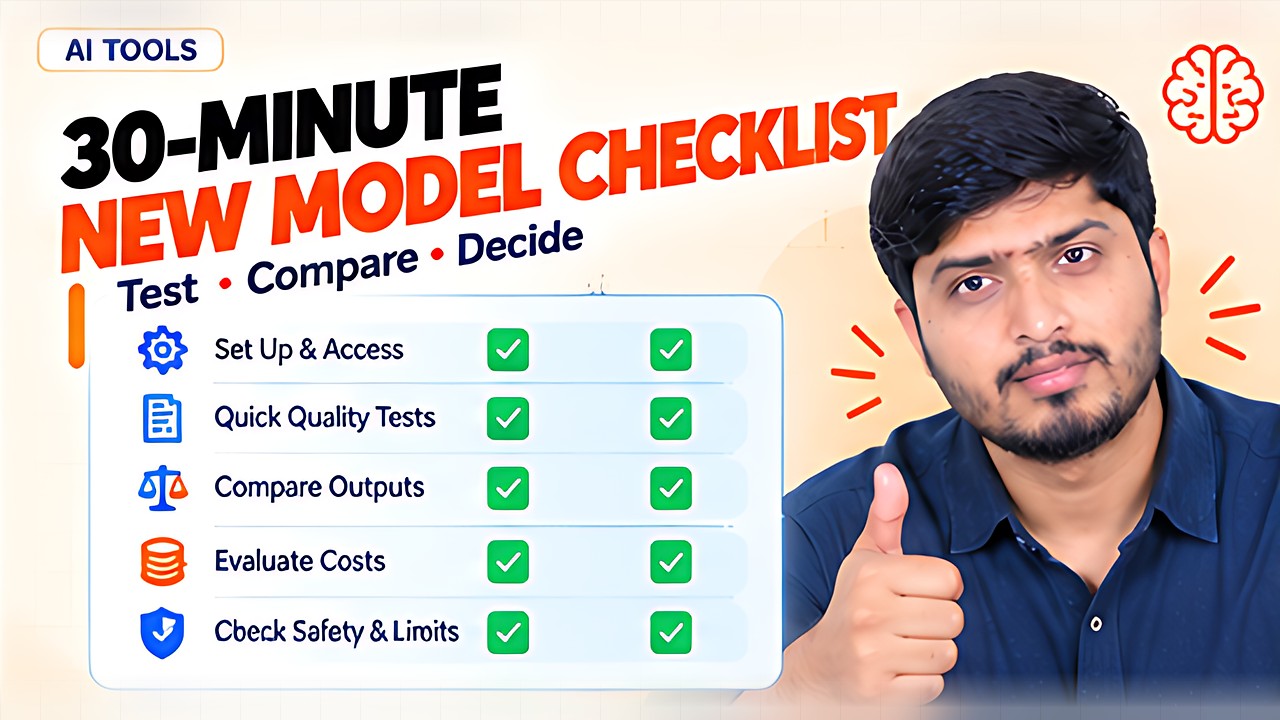
The 30-minute checklist
- Read the basics (5 min): context window, price per million tokens, rate limits, data-use terms, and whether tools and structured output are supported.
- Run your golden prompts (10 min): 10 prompts from your real work, saved, so every model gets the same test.
- Try to break it (5 min): ambiguous questions, missing data, a request it should refuse.
- Measure (5 min): time to first token, total latency and cost for the same task.
- Check formats (3 min): does it return valid JSON and call tools correctly every time?
- Decide (2 min): replace, route some traffic to it, or ignore for now.
Extract the following into JSON with keys name, date (ISO 8601), amount (number) and currency. If a field is missing use null. Text: “Invoice from Acme Ltd dated 3 March 2026 for 1,250.50 euros.” Return only JSON.
What was our company's revenue in Q3? If you do not have the data, say so and list what you would need.
A good model says it doesn't know. A risky one invents a number.
Write a 3-bullet summary of the text below. Each bullet must start with a verb, be under 12 words, and the final bullet must end with a question mark. Text: [paste a paragraph]
Cheaper is often the right answer
For many tasks a smaller, faster model is enough, and the best systems route each request to the cheapest model that can do the job. You can see that trade-off in the playground: switch between Fast, Balanced and Deep and watch cost, latency and quality change.

