A repeatable workflow for AI UGC ads: from one product to ten variants
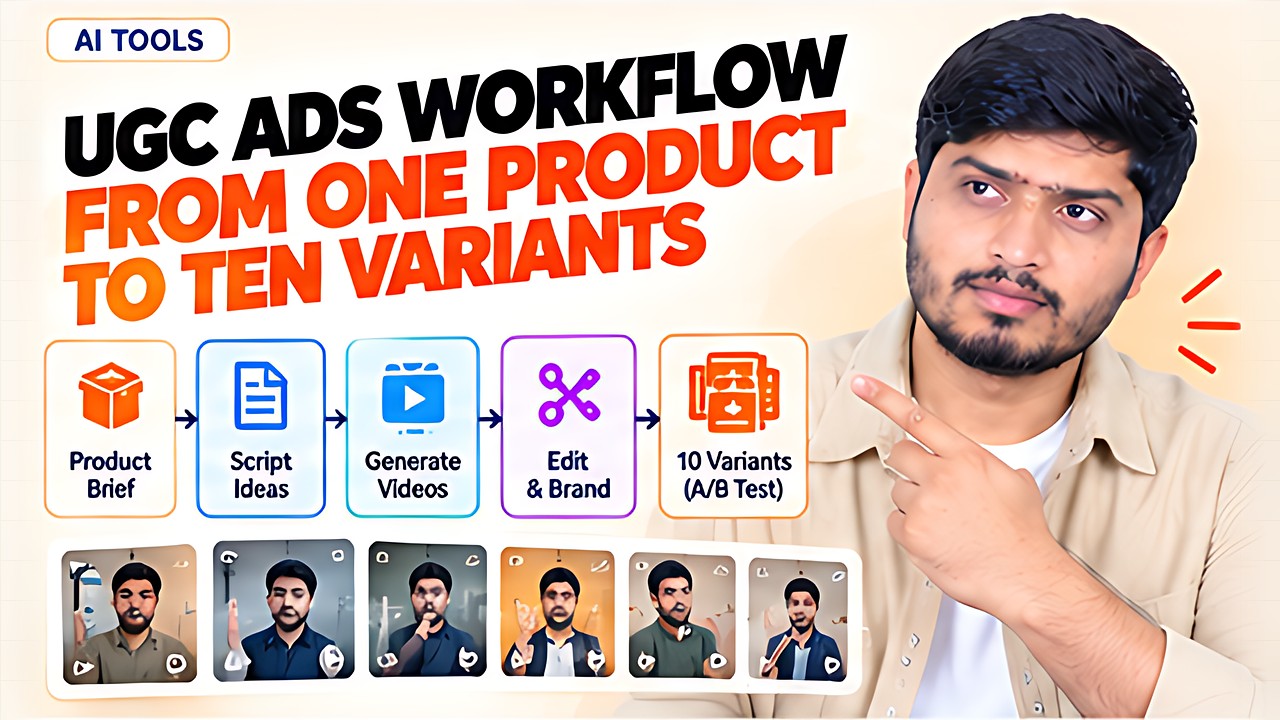
UGC-style ads work because they look like a person recommending something, not a brand announcing it. AI makes it cheap to try many versions. Agency write-ups describe AI UGC mostly as a way to test ideas before commissioning real creators, which is a sensible way to use it.
The workflow
- Brief. One sentence each: the product, who it is for, the single claim you can prove, and the action you want.
- Hooks. Generate 10 opening lines. The first 2 seconds decide whether anyone stays.
- Script. Write 15 seconds in beats: hook, problem, demo, proof, call to action.
- Visuals. Pick angles for each beat (see the camera angle cheat sheet) and generate or film them.
- Voice and captions. Natural pacing, burned-in captions, no jargon.
- Variants. Change one thing at a time: hook or call to action, not both.
- Review. Check every claim and any required AI-content label before publishing.
You write short-form ad hooks. Product: [product]. Audience: [who]. The one claim we can prove: [claim]. Write 10 hooks of under 12 words each, in 5 styles: question, bold claim, mistake to avoid, before/after, curiosity gap. No exaggerated promises.
Write a 15-second vertical ad script for [product] in a friendly first-person voice. Use this hook: “[hook]”. Beats: 0–3s hook, 3–7s the problem, 7–12s a quick demo, 12–15s call to action “[action]”. For each beat give the spoken line and a one-line shot description with a camera angle. Do not make claims that are not in: [proof].
Keep the proof list short and true. The model will happily invent the rest.
A simple variant matrix
| Variant | Hook | Call to action | Everything else |
|---|---|---|---|
| A | Question | Shop now | Same |
| B | Bold claim | Shop now | Same |
| C | Question | Get 10% off | Same |
| D | Mistake to avoid | Shop now | Same |